

Canada Start-Up Visa Minimum Investment & Settlement Funds (2026 Guide)
Does Canada require personal capital for the Start-Up Visa? Explore the statutory 50% LICO formula, designated entity capital thresholds, and operational intake rules.
Immigration and Refugees Law
Reading Time
9 MINUTE READ
If a Canadian refugee officer thinks you are lying, you do not need to prove your innocence in a criminal sense; instead, you must establish the legal credibility of your narrative by providing a consistent story, offering clear explanations for any contradictions, and presenting available independent documentary evidence. Under Canadian law, decision-makers are legally prohibited from rejecting your asylum claim based entirely on minor, peripheral inconsistencies, personal speculation, or by ignoring your reasonable explanations.
To protect your rights and ensure your case is presented effectively, it is highly recommended to consult with an experienced Canadian refugee lawyer.
During a refugee assessment before the Refugee Protection Division (RPD) or during an interview with Immigration, Refugees and Citizenship Canada (IRCC) or the Canada Border Services Agency (CBSA), credibility is the cornerstone of your application. When an adjudicator suspects dishonesty, your entire claim is put at risk. At Pax Law Corporation, we emphasize that understanding your statutory rights and knowing how to leverage Federal Court jurisprudence can help salvage a case even when an officer expresses deep skepticism.
In Canadian refugee law, the initial burden of proof rests squarely on the claimant. According to the Immigration and Refugee Protection Act (IRPA):
“The burden of proving that a claim is eligible to be referred to the Refugee Protection Division rests on the claimant, who must answer truthfully all questions put to them.”
However, the law balances this heavy burden by guaranteeing you an absolute right to present your case fairly. Under IRPA, s. 170(e), the tribunal:
“must give the person and the Minister a reasonable opportunity to present evidence, question witnesses and make representations”
Furthermore, IRPA, s. 170(h) dictates that the panel:
“may receive and base a decision on evidence that is adduced in the proceedings and considered credible or trustworthy in the circumstances”
The following table outlines the statutory balance between your responsibilities and your legal rights under Canadian law:
Skepticism from a decision-maker usually arises from specific vulnerabilities within your application file. The most common triggers include:
If a Canadian refugee officer thinks you are lying based purely on minor details, Canadian jurisprudence is heavily in your favor. The Federal Court of Canada has repeatedly ruled that trivial errors cannot be used to destroy the core credibility of an asylum seeker.
In the landmark case Apena v. Canada (Citizenship and Immigration), 2023 FC 91, the Federal Court overturned a negative Refugee Appeal Division (RAD) decision because the member focused too heavily on irrelevant details. The Court noted at paragraph 3:
“The RAD based its credibility assessments on microscopic findings that are immaterial to core aspects of the Applicant’s claim.”
The Court added at paragraph 41:
“This is too granular a basis upon which to undermine the Applicant’s claim…”
Similarly, in Ehigiator v. Canada (Citizenship and Immigration), 2023 FC 308 at paragraph 89, the Court re-established this vital protective principle:
“the RPD cannot base a negative credibility finding on minor contradictions that are secondary or peripheral to the refugee protection claim. The decision-maker must not conduct a too granular or overzealous analysis of the evidence.”
This protective legal standard was also upheld in Francisco v. Canada (Citizenship and Immigration), 2018 FC 456, where a tiny discrepancy regarding a peripheral detail was deemed far too “microscopic” to undermine an applicant’s core story of persecution.
Procedural fairness dictates that if an RPD member or an IRCC officer intends to rely on an inconsistency to impugn your character, they must give you a fair opportunity to address it during the hearing. In Shmihelskyy v. Canada (Citizenship and Immigration), 2016 FC 123 at paragraph 15, the Court stated:
“any inconsistencies should have been put to the Applicant to provide him with an opportunity to address them … particularly if used to impugn his credibility”
If a decision-maker rejects your application based on an inconsistency that was never raised with you during your testimony, it may constitute a serious breach of natural justice. When confronted with an apparent contradiction, you should immediately:
Decision-makers cannot rely on subjective intuition, personal assumptions, or arbitrary beliefs about how foreign governments or police forces operate. They cannot declare your story “implausible” simply because it sounds unusual to a Canadian observer. The Court in Shmihelskyy explicitly stated at paragraph 5 and paragraph 19:
“where credibility findings rest on plausibility determinations, the implausibility must be clear and the RPD should provide a reliable and verifiable evidentiary base for its plausibility finding”
If an officer states that it is “unlikely” a corrupt police force would act in a certain way, but they lack country-condition evidence to back up that claim, their finding constitutes an error of law.
Corroborating documentary evidence can salvage your application if a Canadian refugee officer thinks you are lying. Credibility is evaluated globally; thus, reliable independent records can offset doubts regarding your oral testimony. If your testimony is questioned, independent evidence may preserve the integrity of your claim, as confirmed in Mohamed v. Canada (Citizenship and Immigration), 2020 FC 186 at paragraph 59:
“if there is any credible or independent evidence capable of supporting the claim, it will have ‘a “credible basis” even if the claimant’s testimony is found not to be credible'”
Adjudicators are legally barred from summarily dismissing your documents as “self-serving” simply because they do not believe your verbal testimony. In George v. Canada (Citizenship and Immigration), 2019 FC 1385, the Court condemned the flawed practice of “adopting a conclusion on credibility without full consideration of the evidence, and then dismissing the evidence on the basis of the finding of credibility.” Decision-makers must evaluate each document independently on its own merits before drawing overall credibility conclusions.
Identity is the foundation of any refugee claim. Under IRPA, s. 106, the RPD must look at whether you possess acceptable identity documents, and if not, whether you have provided a “reasonable explanation” or taken “reasonable steps” to obtain them. A lack of identity documents without a valid explanation can severely damage your credibility across the entire file.
Many inconsistencies stem from psychological trauma, post-traumatic stress disorder (PTSD), severe anxiety, or interpretation failures rather than deceit. The Immigration and Refugee Board (IRB) recognizes this through its official Chairperson’s Guideline 8 regarding vulnerable persons. Section 15.7 of Guideline 8 explicitly acknowledges:
“trauma may impact memory, which can produce inconsistencies, omissions, and vagueness in the individual’s testimony.”
Section 5.2.3 requires decision-makers to “anticipate the possibility that trauma may impact a person’s memory,” while Section 9.3 mandates that the IRB provide “reasonable accommodations” to guarantee absolute procedural fairness. If you suffer from trauma-induced memory issues, it is vital to submit a professional psychological report to the IRB before your hearing to protect your case.
To systematically demonstrate your truthfulness and protect your narrative, review this practical operational checklist:
If the RPD rejects your refugee claim based on an adverse credibility assessment, you still have viable legal pathways to challenge the ruling. In most instances, you have the right to file an appeal with the Refugee Appeal Division (RAD) pursuant to IRPA, s. 110(1). However, be aware that if the RPD labels your claim as having “no credible basis” or being “manifestly unfounded,” your right to appeal to the RAD is restricted under IRPA, s. 110(2)(c).
When appealing to the RAD, your legal memorandum must strictly adhere to Rule 3 of the RAD Rules, providing exhaustive submissions regarding the specific errors made by the RPD. If you possess new evidence that was unavailable at the time of your initial hearing, it must meet the strict admissibility criteria outlined in IRPA, s. 110(4). If the RAD denies your appeal or if your case bypasses the RAD, you can seek judicial review before the Federal Court of Canada, which regularly overturns unreasonable, speculative, and procedurally unfair credibility assessments.
For strategic advice tailored to your specific situation, contact the dedicated legal team at Pax Law Corporation to review your options.
No. Refugee proceedings are not criminal. You must establish the overall credibility and trustworthiness of your narrative based on a balance of probabilities, not criminal innocence.
According to Federal Court jurisprudence like Apena v. Canada, decisions cannot be based on microscopic or granular findings that are immaterial to the core of your claim.
You have a legal right to a fair hearing. Clearly clarify which version is correct, explain the reason for the discrepancy (such as interpretation errors or trauma), and request clarifications if needed.
No. Under Shmihelskyy v. Canada, any finding of implausibility must be clear, reliable, and backed by a verifiable evidentiary base, not mere personal speculation.
The information presented is for informational and educational purposes only and may not be accurate. This information does not replace getting legal advice from a qualified, practicing lawyer. If you are facing a legal dilemma, you should make an appointment and consult with one of our licensed and practicing lawyers.
Does Canada require personal capital for the Start-Up Visa? Explore the statutory 50% LICO formula, designated entity capital thresholds, and operational intake rules.

Wondering which Canadian permanent residency stream saves the most time and money? We analyze statutory IRPA requirements, hidden costs, and application timelines to help you determine your most practical pathway.
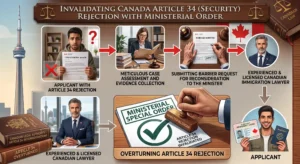
Seeking to overturn a Canadian security inadmissibility refusal under Section 34? Understand how a formal Ministerial Relief declaration under Section 42.1 or a Federal Court Judicial Review can resolve your case.
Schedule an initial consultation with one of our lawyers to review your case and get clear next steps
or details on how to pay your retainer fee, please visit the page below
A full-service Canadian law firm serving Vancouver & Toronto.
0 Comments